Project Overview
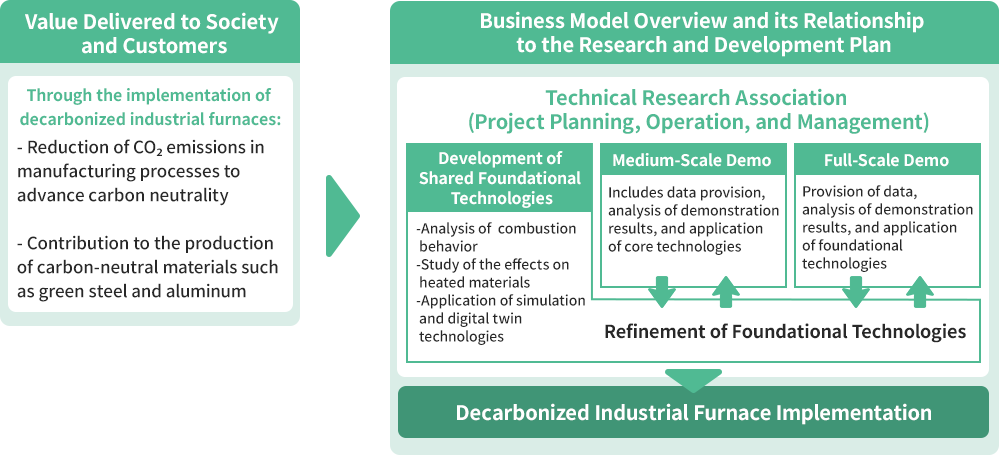
The amount of CO₂ emission from the manufacturing sector is 150Mtons per year, which is about 13.5% of Japan’s annual CO₂ emission. The main source of CO₂ emission from the manufacturing processes is industrial furnaces. About 39,000 industrial furnaces are used for heating metals in the manufacturing processes. Therefore, decarbonization of industrial furnaces should be done for making the decarbonized society by 2050. Two types of industrial furnaces are used in the manufacturing processes: Combustion furnaces and Electric furnaces.
For combustion furnaces, carbon-free fuels such as ammonia and hydrogen, which produce no CO₂ during combustion, are considered as alternatives. However, the use of these fuels requires addressing challenges such as those associated with preventing chemical reactions like nitriding and hydrogen embrittlement on metal products, as well as ensuring combustion stability and reducing NOx emissions. The organization is carrying out the development of combustion technologies to address these challenges.
Meanwhile, electric furnaces, which do not emit CO₂, is the other way for decarbonization.
However, several challenges are necessary for converting from a combustion furnace to an electric furnace. DITS is developing technologies to minimize power reception capacity and to improve efficiency in order to smoothly transition to electric furnaces.
R&D Items
1. Research on Fundamental Technologies Applying Decarbonized Fuels to the Industrial Furnaces
2. Development of Industrial Furnaces with decarbonized fuels such as hydrogen and ammonia
3. Development of Electric Furnaces with Higher Efficiency and Lower Power Supply Capacity
4. Market Research on the Decarbonized Industrial Furnaces
Development Targets
Combustion Furnaces
Large Furnaces
Small and Medium-Sized Furnaces
Electric Furnaces
Larger size combustion furnaces
| Steel Heating Furnace | Steel Process Furnaces | Steel Forging Furnace | Aluminum Melting Furnace | |
|---|---|---|---|---|
| Appearance | 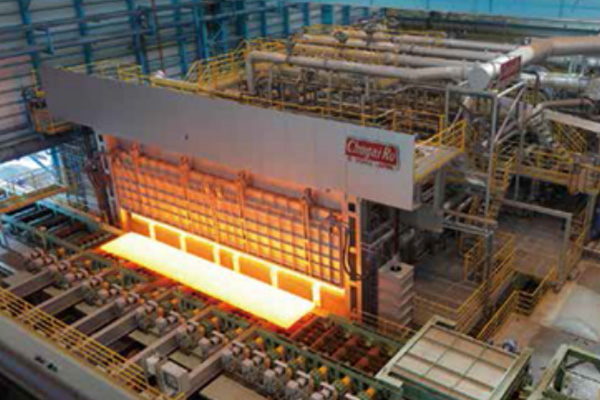 | 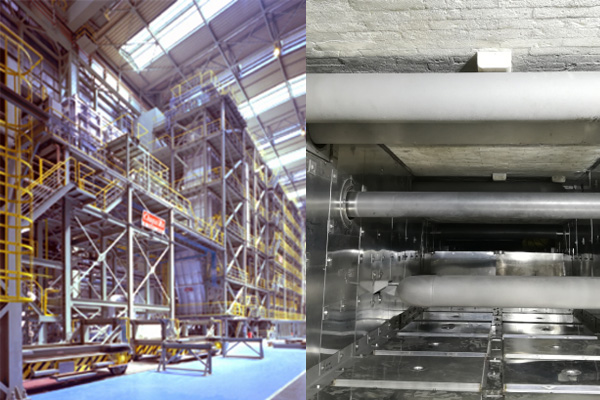 | 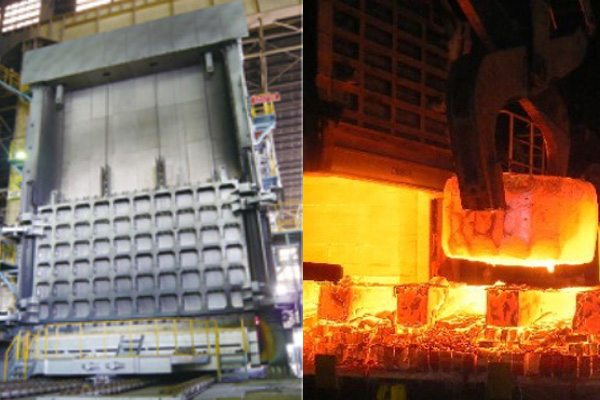 | 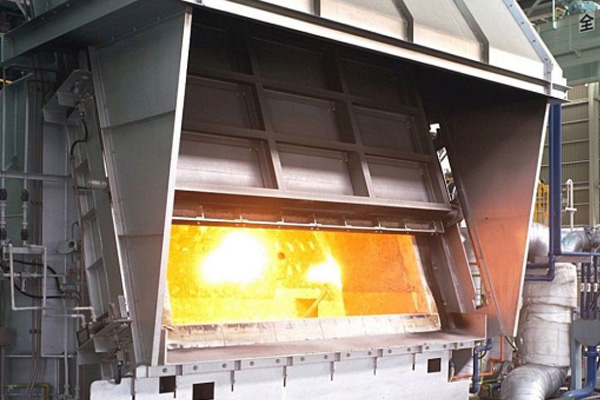 |
| Usage | Ironmaking (heating slabs prior to hot-rolling) | Ironmaking (heating for microstructure adjustment in the final stage of sheet metal production) | Steel forging (heating of forging materials) | Aluminium materials (ingot melting) |
| Furnace temp. | MAX. 1400℃ | MAX. 950℃ | MAX. 1400℃ | MAX. 1200℃ |
| Capacity | MAX. 180MW | MAX. 18MW | MAX. 9MW | MAX. 19MW |
| Dimensions | 11mW x 56mL x 5mH | 2.4mW x 16mL x 25mH | 8mW x 13mL x 8mH | Ф10m x 5mH |
Smaller and medium sizes of combustion furnaces and electric furnaces
| Ammonia Fired Radiant tube burner | Inductive and resistive hybrid | Ammonia reforming unit | |
|---|---|---|---|
| Appearance | 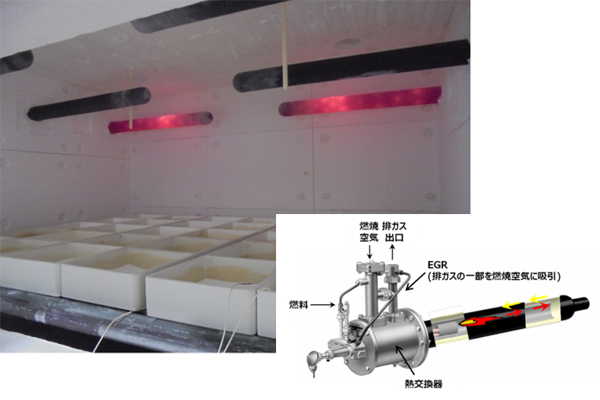 | 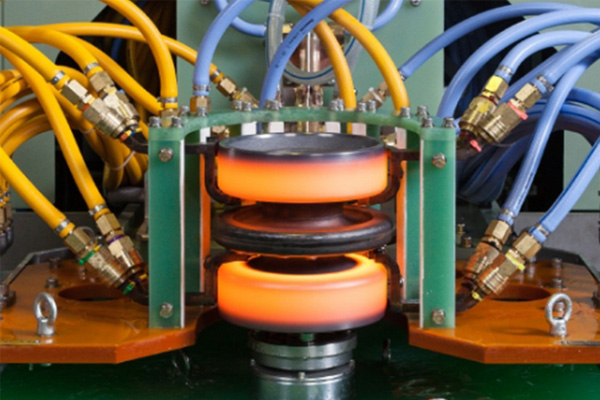 Figure shows the induction device section. | 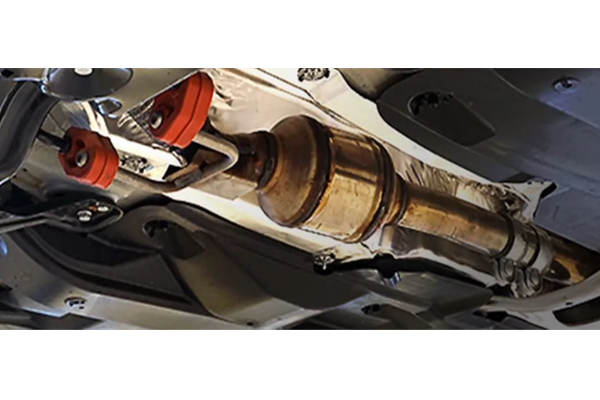 |
| Usage | Heat treatment | Heat treatment | Attachment of Burner System |
| Features | ・Indirect heating system. ・Stable combustion is required in the narrow space inside the tube | ・Hybrid of induction furnace using electromagnetic induction of coils and resistance furnace using electrical resistance. | ・Catalytic reforming of ammonia to hydrogen. |
| Heating temperature, dimensions, etc. | Max. Temp.: 1000℃ Capacity: ①150kW、600℃ ②300kW、1000℃ | Max. Temp.: 600℃ Size:1~2mW×1.8~2.3mL×1.5×2.0mH | Capacity:50~400kW class Size:Φ0.3m×1m |
Implementation Flow